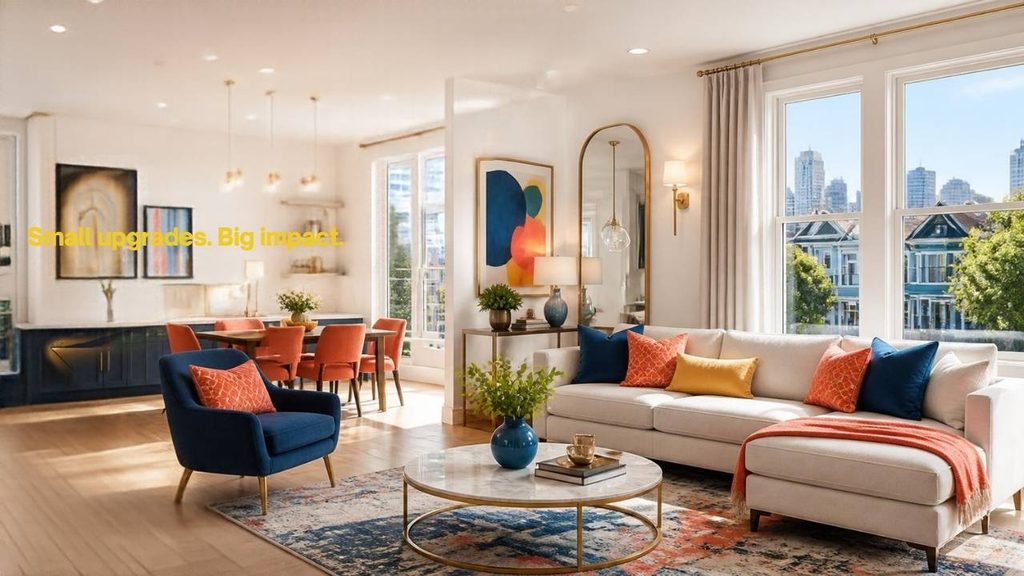
Walk into certain homes and you feel it immediately: calm, polished, expensive. Then you look around and realize nothing in the room cost much.
Meanwhile, plenty of homes full of costly furniture somehow feel cluttered and cheap.
The difference isn’t money. It’s ten small decisions most people never think about. Get them right and your home looks like it was designed by a professional. Get them wrong and no budget can save it.
1. Clutter Is the Fastest Way to Look Cheap
Nothing destroys an expensive look faster than too many objects. Every extra item on a table, shelf, or counter competes for attention, and the room starts to feel chaotic.
Try this: leave about one third of every surface empty. On a shelf, display three or four things you truly love instead of fifteen things you don’t notice anymore. Put everyday items in baskets, boxes, and closed cabinets.
Empty space isn’t wasted space. It’s what makes the rest look valuable.
2. Short Curtains Make Your Whole Room Look Smaller
Curtains are the most underrated upgrade in any home. Curtains that stop at the window frame make the ceiling look lower and the room look unfinished.
Hang the rod 10 to 15 cm above the window frame, or even close to the ceiling. Let the curtains fall to just touch the floor. Choose fabric about two times the width of the window so it hangs in soft folds instead of looking flat.
Stick to plain fabrics in calm colors. Busy patterns look cheaper, not richer.
3. One Ceiling Light Is Flattering to Nobody
A single bright light in the middle of the ceiling flattens a room and makes everything look like an office. Expensive looking rooms use layers of light at different heights.
Aim for at least three sources in every room: a floor lamp in a corner, a table lamp on a sideboard or shelf, and a softer overhead or accent light. Choose warm bulbs around 2700K, and add dimmers if you can.
Cold white bulbs make even a beautiful room look like a waiting room. Warm light makes a simple room feel like a hotel lounge.
4. Too Many Colors Make a Room Look Random
A cohesive color scheme is the hidden secret of elegant interiors. Use a simple rule: about 60 percent a main neutral (cream, warm gray, beige), 30 percent a second tone (soft brown, muted green, deeper gray), and 10 percent an accent in cushions, art, or a rug.
Then repeat those colors in other places in the room. Repetition tells the eye the room was planned, and planned is exactly how expensive looks.
5. A Wall of Small Pictures Looks Cheaper Than One Big One
Many small frames scattered across a wall look busy and accidental. One large piece looks confident.
Choose art that is about two thirds the width of the sofa or console below it, and hang it so the center sits around 145 cm from the floor, roughly eye level. It doesn’t need to be an original. A well framed print or photograph in a good frame, ideally with a wide mat, looks far more expensive than it is.
The frame and the placement matter more than the price of the picture.
6. Cheap Hardware Gives Away Cheap Furniture
Look closely at the cabinet handles, drawer pulls, and light switches in your home. If they’re flimsy, shiny, or mismatched, they quietly cancel out everything else you’ve done.
Swapping handles on a kitchen or a dresser takes less than an hour and can transform the piece. Keep finishes consistent throughout a room: all brushed brass, or all matte black, not a bit of everything.
This is the cheapest upgrade on the list and one of the most dramatic.
7. A Big Mirror Is Free Light
A large mirror placed opposite or beside a window doubles the daylight and makes a room feel bigger and calmer. In a small space or a dark hallway, it can change the whole atmosphere.
Go big. A small mirror looks like an afterthought, while a large one looks like a design decision. Choose a simple frame that matches your furniture, and make sure it reflects something worth seeing, like a window, a lamp, or a nice piece of art, and not a pile of laundry.
8. Your Bed Is Costing You Your Hotel Look
Hotels don’t use magic. They use plain bedding, good layering, and a perfectly made bed.
Stick to one or two colors, preferably white or soft neutrals. Add two or three pillows that match, a folded throw across the foot of the bed, and keep the surface smooth. Fluffy pillows and clean, wrinkle free sheets do more than an expensive duvet cover ever will.
Make the bed every morning. It takes one minute and changes how the whole room looks.
9. One Big Plant Beats Ten Tiny Ones
A single large plant in a good pot fills an empty corner and makes a room feel alive and finished. A crowd of small plants on every surface looks messy.
Choose one or two statement plants, and put them in simple pots in neutral colors. If keeping plants alive isn’t your talent, a high quality artificial one works, as long as it’s large and the leaves look real.
10. Stop Buying More Stuff
This is the rule behind all the others. Expensive looking homes aren’t full of things. They’re full of choices.
One beautiful lamp beats five cheap decorations. One well made chair or quality rug does more for a room than a shelf full of souvenirs. Before you buy anything, ask yourself one question: does this make the room better, or does it just fill it?
If you’re not sure, leave the space empty. Empty almost always looks better than filled with the wrong thing.
Your Home Isn’t Cheap. It’s Just Unedited
The good news is that none of these fixes require a renovation or a big budget. They require attention, and a willingness to remove more than you add.
So don’t try to do everything at once. Pick one thing from this list and do it today: raise the curtain rod, remove half the objects from your coffee table, or replace that one ugly handle.
Then step back, look at the room again, and notice the difference. That moment is usually all it takes to get hooked.